In the Park
Gwen Harwood's 'In the Park' is a devastatingly honest, subversive poem that strips away the romanticised myths of motherhood to reveal the isolating reality underneath. It is incredibly rewarding to study because its strict sonnet form perfectly masks, and then reveals, the chaotic emotional truth of a woman who has been 'eaten alive' by domestic expectations.
Study Notes

Overview
Published in 1961 under the male pseudonym Walter Lehmann, Gwen Harwood's 'In the Park' remains one of the most powerful explorations of maternal ambivalence in Australian literature. The poem presents a bleak, unflinching portrait of a woman whose identity has been entirely subsumed by her role as a mother. Examiners reward candidates who can look beyond the surface narrative to analyse the profound irony of using a Petrarchan sonnet — a form traditionally reserved for romantic love — to articulate the crushing realities of domestic duty and the loss of self. A strong response will consistently link the poem's structural shifts to the speaker's emotional state, particularly the tension between her public performance and private despair.
Podcast Episode
Listen to our 10-minute deep dive into 'In the Park' for expert analysis, examiner tips, and a quick-fire recall quiz.
Plot/Content Overview
The poem follows a simple, chronological narrative in a single setting:
Stanza 1 (Lines 1-4): An unnamed woman sits in a park with her three children, who are demanding and restless. An old lover happens to walk past.
Stanza 2 (Lines 5-8): The woman and her former lover exchange hollow social pleasantries. The man internally expresses relief that he did not end up with her.
Stanza 3 (Lines 9-14): The woman performs the role of the happy, fulfilled mother for his benefit. However, as he walks away, she is left alone to confess her devastating truth to the wind.
Themes
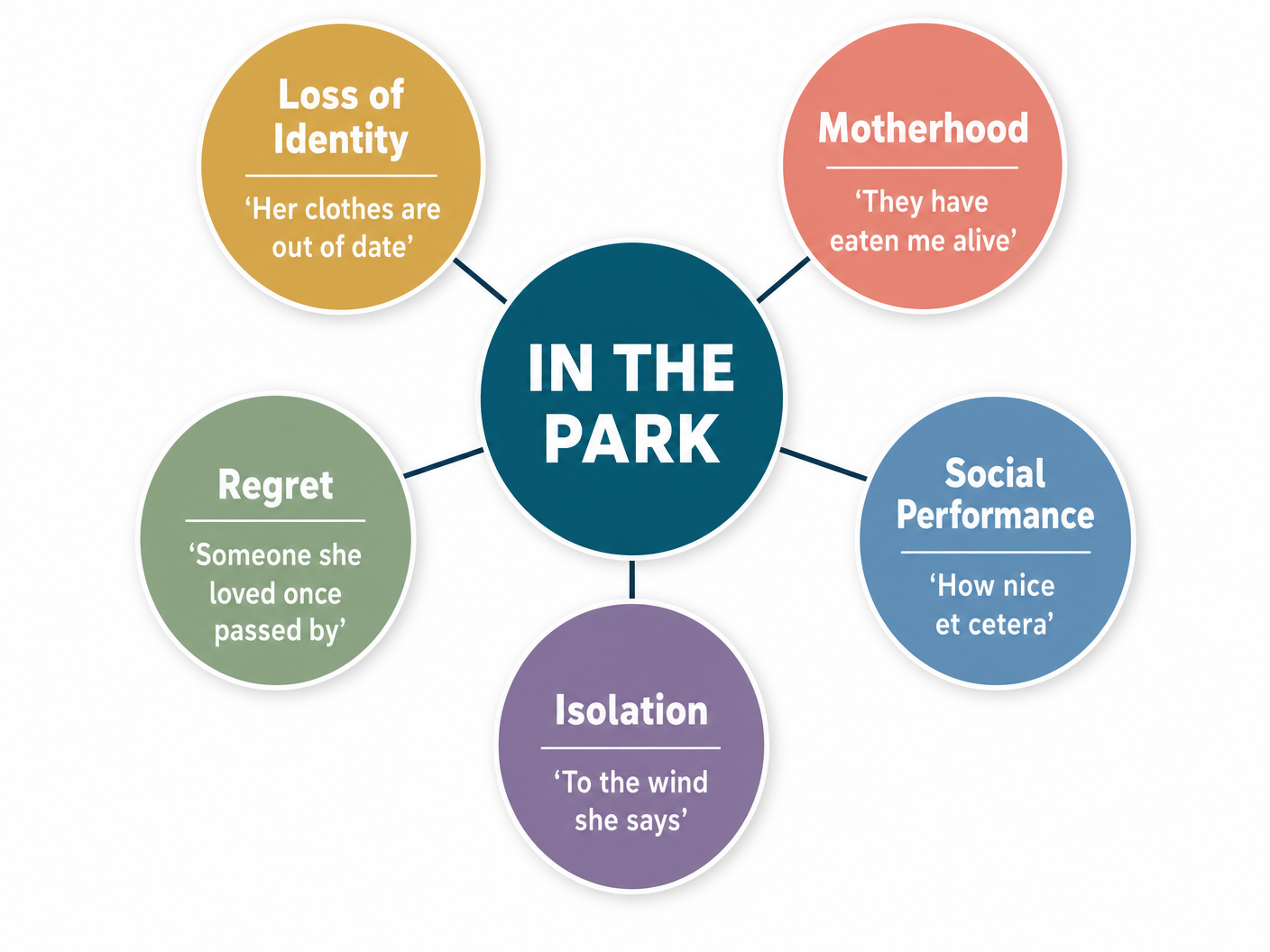
Theme 1: The Consuming Nature of Motherhood
Harwood subverts the traditional 'Madonna and Child' idealisation of motherhood, presenting it instead as a relentless, exhausting force that demands total sacrifice. The children are not depicted as sources of joy, but as agents of consumption.
Key Quotes:
- "Two children whine and bicker, tug her skirt" (Line 2) - The verbs here are harsh and demanding, emphasising the physical and auditory intrusion of the children on the woman's peace.
- "They have eaten me alive" (Line 14) - This violent, visceral metaphor is the emotional climax of the poem. It suggests total consumption; her identity, energy, and selfhood have been devoured by her maternal responsibilities.
Theme 2: Loss of Identity and Stagnation
The poem suggests that long-term domestic responsibility slowly erases a person's individual identity, leaving them defined solely by their function as a caregiver.
Key Quotes:
- "She sits in the park. Her clothes are out of date." (Line 1) - The blunt, paratactic opening sentences establish her stagnation. She is unnamed (just "She"), and her outdated clothes symbolise how time and the wider world have passed her by.
- "Someone she loved once passed by" (Line 4) - The encounter with the ex-lover highlights the contrast between her past self (someone capable of romantic love and being loved) and her present self (reduced to a maternal function).
Theme 3: Social Performance vs. Private Reality
Harwood exposes the societal pressure on women to appear content and grateful in their maternal roles, forcing them to hide their true feelings behind acceptable social manners.
Key Quotes:
- "'How nice' et cetera." (Line 6) - The use of cliché and the dismissive "et cetera" highlights the hollowness of their social exchange. It is a performance of politeness masking deep discomfort.
- "It's so sweet / to hear their chatter, watch them grow and thrive" (Lines 10-11) - This is the socially expected script of motherhood. The irony is palpable, as it directly contradicts the reality we saw in the first stanza where the children "whine and bicker".
Character Analysis
The Mother ('She')
Role: The central protagonist, trapped in domesticity.
Key Traits: Exhausted, resigned, isolated, performing a role.
Character Arc: Moves from passive observation to forced social performance, culminating in a devastating private confession of defeat.
Essential Quotes:
- "Her clothes are out of date."
- "To the wind she says, 'They have eaten me alive.'"
The Former Lover
Role: A catalyst for the mother's reflection; a symbol of the world she left behind.
Key Traits: Neat, socially polite, internally judgemental, relieved.
Essential Quotes:
- "From his neat head unquestionably rises / a small balloon... 'but for the grace of God...'"
- "his departing smile"
Writer's Methods
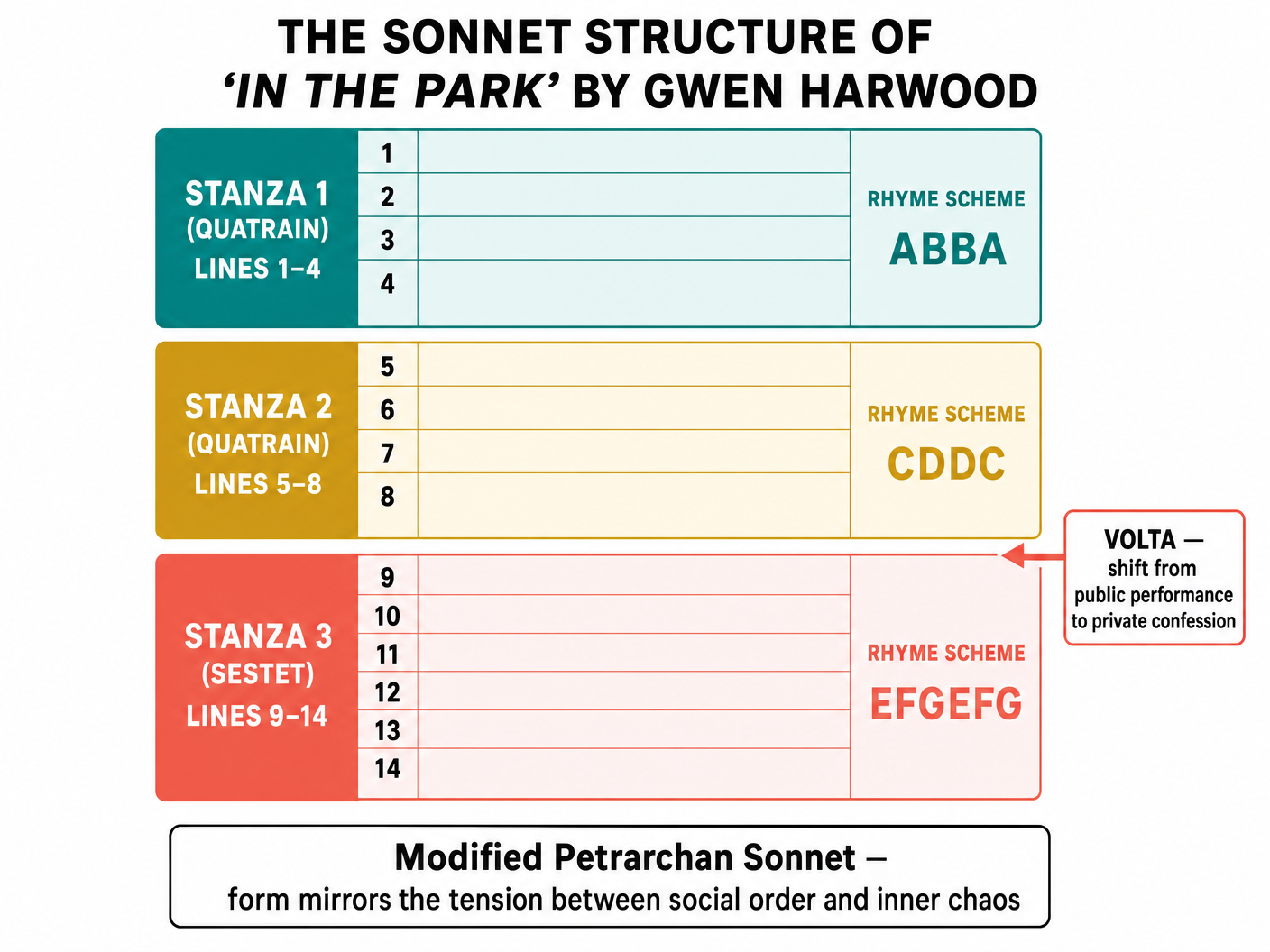
Form and Structure: Harwood uses a modified Petrarchan sonnet (14 lines: two quatrains and a sestet). The use of the sonnet — traditionally a form for romantic love poetry — is deeply ironic, contrasting the idealised concept of love with the grim reality of its domestic consequences. The volta (turn) occurs at line 9 ("They stand a while"), shifting the focus from the awkward encounter toward the final, devastating revelation.
Enjambment: The most significant use of enjambment occurs between stanzas one and two: "too late / to feign indifference". This structural overflow mimics the woman's loss of control; the moment happens too quickly for her to prepare her social mask.
Imagery and Metaphor: The "flickering light" (Line 9) serves as a visual metaphor for the woman's unstable emotional state and fading hope. The comic-book imagery of the "small balloon" (Line 8) rising from the man's head satirises his smug relief, contrasting sharply with the tragic reality of the woman's situation.
Context
1960s Australia: Written in 1961, before second-wave feminism had gained widespread traction, the poem reflects a society where women were largely confined to the domestic sphere. The expectation was that motherhood was a woman's ultimate fulfillment. Harwood's expression of maternal regret was highly subversive, evidenced by her decision to publish it under the male pseudonym 'Walter Lehmann'. Examiners reward candidates who connect this context to the poem's themes of isolation and the necessity of the woman's "performance" of happiness.
Visual Resources
2 diagrams and illustrations
Interactive Diagrams
1 interactive diagram to visualise key concepts
Conceptual Flow Outline
The narrative and emotional structure of 'In the Park'
Worked Examples
1 detailed example with solutions and examiner commentary
Practice Questions
Test your understanding — click to reveal model answers
Explore how Harwood uses form and structure to convey the speaker's feelings in 'In the Park'. (30 marks)
Hint: Don't just mention that it's a sonnet — explain *why* it's a sonnet. What is the irony? Also, look at the enjambment between stanzas 1 and 2.
How does Harwood present the theme of isolation in the poem? (30 marks)
Hint: Consider how she is isolated despite being surrounded by people (her children, her ex-lover).